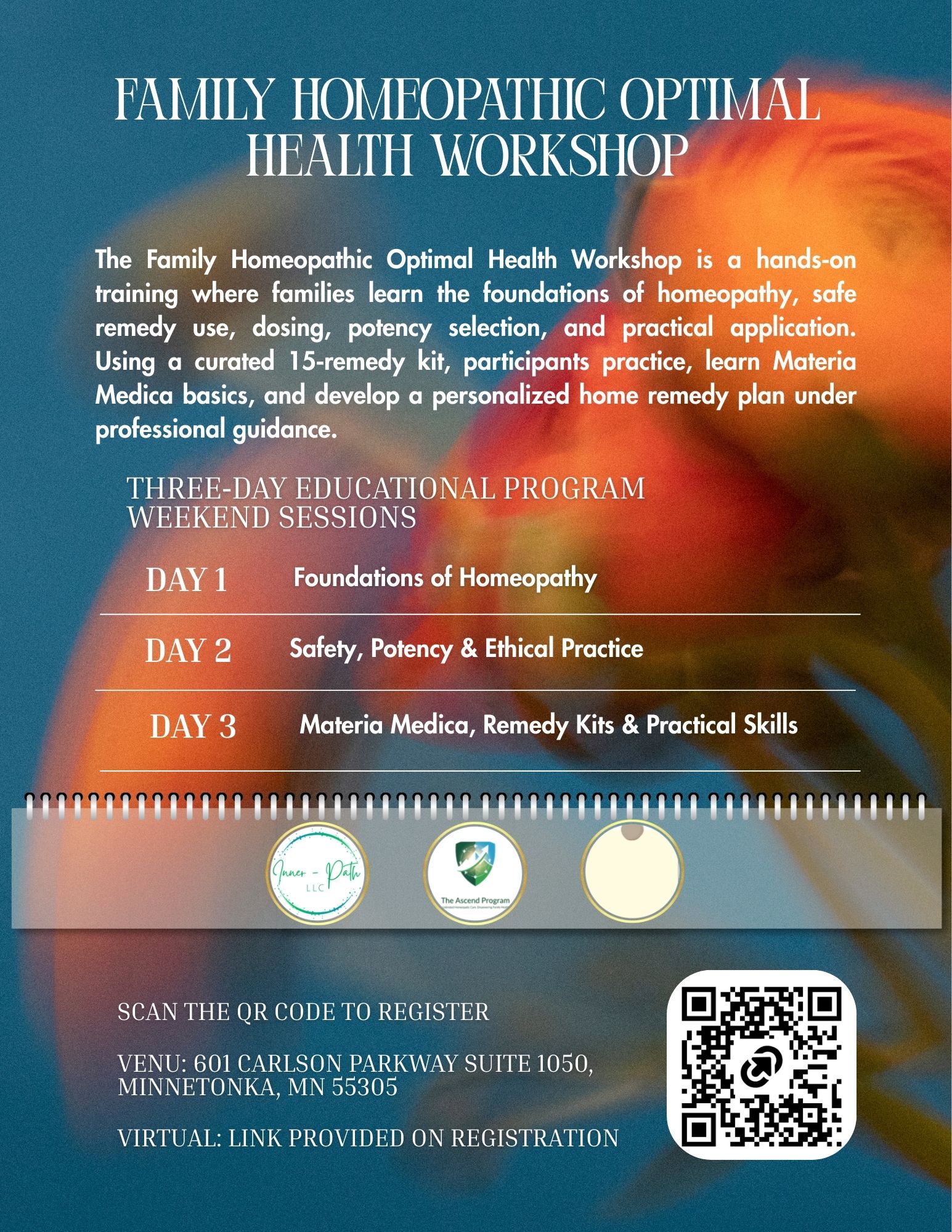
FAMILY HOMEOPATHIC OPTIMAL HEALTH WORKSHOP
A 3‑Day Weekend Experience for Families
Learn to Support Your Family’s Health — Naturally
A gentle, practical, hands‑on workshop where families discover how to use safe homeopathic remedies for everyday wellness, stress, injuries, and emotional balance.
Frequently Asked Questions
1. What is the purpose of this program?
The program is an educational workshop designed to teach families the foundations of homeopathy, safe remedy use, and responsible self‑care for minor, acute conditions. It emphasizes ethical practice, proper dosing, potency selection, and clear guidance on when professional or medical care is required.
2. Is this program promotional or sales‑driven?
No. This is a structured educational program, not a sales presentation. While remedies are demonstrated for learning purposes, the focus is on safe use, education, and informed decision‑making, not product selling.
3. How are pharmacy products featured?
Sponsored pharmacy remedies are:
Used during live demonstrations
Included in the curated 15‑remedy family kit
Referenced in workbooks and practice exercises
Highlighted as trusted sources for ongoing supply
This provides authentic brand exposure within an educational context.
4. What types of conditions are covered?
The program focuses exclusively on minor, acute, self‑limiting conditions, such as:
Minor injuries and bruising
Mild fevers and colds
Digestive discomfort
Teething and minor childhood complaints
Emotional upsets (stress, grief, irritability)
Chronic, complex, or serious conditions are explicitly excluded from self‑treatment instruction.
5. How is safety addressed?
Safety is a core pillar of the program. Participants are taught:
When self‑care is appropriate vs. when to seek medical help
Proper dosing and potency selection
“Stop when improvement begins”
Avoiding overuse and unnecessary repetition
Clear red flags for referral or emergency care
6. Are medical claims made?
No. The program does not diagnose, treat, or claim to cure disease.
All content is framed as educational, supporting informed use of homeopathic products within appropriate boundaries.
7. Who teaches the program?
The workshop is led by trained homeopathy educators with experience in family care, safety standards, and ethical instruction. The role of the educator is clearly defined as educational, not medical.
8. Is this suitable for children?
Yes, with clear guidelines. The program teaches:
Age‑appropriate dosing
Parental supervision
Conservative potency use
When pediatric or medical care is required
Safety for infants and children is emphasized throughout.
9. How are potencies handled?
Participants are taught:
Low potencies (6C–12C) for localized physical symptoms
Medium potency (30C) for common acute conditions
High potencies discussed conceptually only, with clear cautions
Unsupervised use of high potencies is discouraged.
10. Does the program discourage conventional medicine?
Absolutely not. The program strongly emphasizes:
Integration, not replacement
Respect for conventional diagnosis and emergency care
Collaboration with healthcare professionals
Seeking medical advice when appropriate
11. What materials do participants receive?
Participants receive:
A professionally designed workbook
A curated 15‑remedy family kit
Dosing charts and safety guidelines
A Family Remedy Planning worksheet
All materials reinforce proper use and pharmacy sourcing.
12. How long is the program?
The workshop runs over three days, totaling approximately 15 hours:
Morning sessions: 9:00 AM – 12:00 PM
Afternoon sessions: 2:00 PM – 3:00 PM
This allows for depth without overload.
13. Is this a certification program?
No. Participants receive a certificate of completion, not a professional credential. The program does not authorize clinical practice.
14. What is the expected audience size?
Ideal group size is 15–20 in-person participants, unlimited online participants allowing for interaction, questions, and hands‑on learning while maintaining a high‑quality experience.
15. Are remedies sold at the event?
Sales are not required and are typically handled outside the educational sessions or via post‑event referrals.